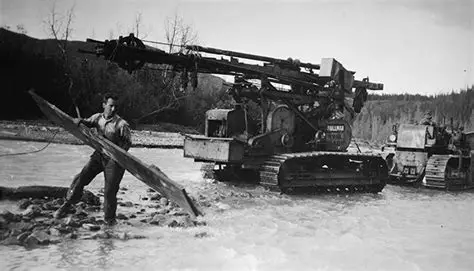
With piles of technical data and thousands of soil sample, Lidar,Ground Penetrating Radar, Drone Surveys etc. information is available on request to qualified interested parties.
PRINCIPAL CREEK – WITH WATER PERMIT
YUKON MINFILE – TEACHERS SHOWING
MINNEAPOLIS CREEK – WITH WATER PERMIT
YUKON MINFILE – GOLDEN SADDLE
YUKON MINFILE – RYANS SURPRISE
MADALENA – SOIL SAMPLES – GEOCHEMISTRY
https://yma.gov.yk.ca/094607.pdf
WHITE GOLD TECHNICAL REPORT
https://www.whitegoldcorp.ca/_resources/reports/ACS_White_Gold_2024_Final_Report.pdf?v=032803
NEEBUR GULCH – GOLD SHOWINGS BLADE and LYNX – UNDER PLACER DEVELOPMENT
Blade is located on a major northwest-southeast trending ridge top approximately 11 km to the east of the Golden Saddle Deposit (Figure 16). Qz-fspar-bt and, qz-fspar gneiss are the dominant surrounding rock types. A large (9 km strike length) east-west fault is inferred on the geological map and observed from subsurface trench data. The majority of surface grab samples from around Blade contain quartz veins. These vary in size from mm-scale quartz veinlets to cm-scale quartz veins + /- cubic pyrite, ± magnetite. K-feldspar commonly forms hydrothermal alteration selvages to these quartz-rich veins. A strongly oxidized zone exists at Blade. The surface extent of this oxidized zone is, however, limited; approximately 10 m wide at surface and the depth remains unknown. Red to orange-coloured soil is often prevalent in areas where the lithologies are inferred to be strongly oxidized. Alteration of pyrite and other sulphide minerals may liberate gold. The most common examples of these are the Fe-oxides, such as limonite, goethite and hematite. Manganese oxide is common on fracture surfaces. There is no indication of supergene enrichment at surface. Oxidation is strongly controlled by fractures/faults and is most prevalent within 50m of the surface. One of the strongest oxidized zones, with an anomalous grab sample (CAD100606) contained 0.87 g/t Au, and 1,250 ppm Pb
The Lynx area (Figure 16) was identified during the 2009 field season whilst following-up on a 110 ppb gold-in-soil anomaly, as well as two 98 percentile government stream sediment anomalies of 0.011 and 0.012 ppm Au. The mineralized area is dominated by packages of felsic gneiss, hornblende gneiss, and quartzite. The geologic controls for the mineralized zone at Lynx are unknown. However, a northwestsoutheast trending structure is inferred from geological mapping and could be a potential mineralizing structure. Dikes in the southwest portion of the Lynx area are oriented north-south and crosscut the felsic gneiss units. These may be potential sources of gold-mineralization. Previous work at Lynx has revealed quartz veining of variable textures. A fine-grained, cherty-looking, quartz vein breccia and quartz vein plus a box-work of oxidized, remnant cubic pyrite has been observed. Fracture-coating oxides are abundant in the quartz-feldspar gneiss host rock. Soils within the vicinity of the Lynx prospect generally have a deep orange hue and likely indicate strongly oxidized zones in the area. A previous grab sample (CAD100247) of strongly oxidized quartz-feldspar from a hand dug pit yielded a high grade gold assay value of 2.68 g/t Au. This sample was taken following-up on previously collected gold-in-soil anomalies in the area. A grab sample (CAD102013) collected in 2010 was described as a sericite, and silica-altered rock with cubic pyrite, limonite staining and variable quartz veining. The sample, composed of rock chips taken from a hand-dug pit, resulted in an anomalous gold assay value of 2.18 g/t Au.